
.avif)
There is no doubt the investment industry is changing.
Over the past few years, private markets and passive strategies have grown rapidly. New asset classes, including green bonds and natural capital, have emerged. Regulation has shifted. And ESG and sustainable finance have come under greater global scrutiny. In the US, political actors have shown a willingness to use litigation to interfere in markets and prop up industries such as fossil fuels. That has created compliance uncertainty in some states, constrained collective engagement, and somewhat disincentivised the setting of formal ESG commitments.
But zoom out, and the vast majority of jurisdictions are leaning into responsible investment. China and India have moved towards mandatory sustainability reporting regimes, with China also adopting a “double materiality” approach. Across APAC, sustainability reporting is accelerating, alongside blended finance initiatives, taxonomies, green loans and carbon market reforms. Meanwhile, the EU continues to embed human rights, nature and climate criteria into trade policy.
This complex global landscape, and the broader upward trajectory of ESG investing and sustainable finance, was on full display at RIAA’s 2026 Australia conference, where industry leaders discussed and workshopped the major themes occupying institutional and impact investors across Australia.
Some key takeouts:
• ESG risks and opportunities remain central to Australian asset owners’ investment decision-making. The celebration of RIAA’s Responsible Investors, Responsible Investment Leaders and Responsible Investment Superfund Leaders showed how determined asset owners and managers are to keep lifting practice while delivering returns for members.
• Australian asset managers increasingly understand the material benefits of doing responsible investment well. They are demonstrating nuanced, sophisticated approaches to issues such as nature, defence sector investing, geopolitical risk and human rights, using a range of data sources to investigate supply chains and there are multiple frameworks to assess risk.
• Sustainability leadership requires authenticity, continuity, a clear focus on the business case, and the ability to cut through noise. Real leaders understand the “why” and ensure sustainability is mainstreamed across the organisation, bringing teams and boards together around a shared mission.
• Australian consumer demand for responsible, sustainable and ethical investment options is shaping both adviser conversations and financial product design, labelling and marketing. Capability is growing in both areas, and RIAA’s Certification Program for financial products, indices and financial advisers gives consumers greater confidence in the advice they seek and the options they choose.
• A responsible investment lens strengthens index strategies, private market investments and emerging asset classes.
• Geopolitical change is, paradoxically, here to stay. It requires new analytical frameworks and data points to help investors minimise the impact of shocks and seize opportunities emerging from geopolitical change.
• Sustainability and ESG professionals can use AI to improve efficiency, scenario analysis, and the measurement of everything from emissions and biodiversity to modern slavery. AI can also help practitioners zoom out and understand how different data points intersect. But good judgement, context and future focus remain essential. The role of the responsible investment professional is changing.
• Systemic risks are becoming impossible to ignore. Take AI: it creates carbon emissions, water stress and community unease; it can reinforce misinformation and bias; it hallucinates; and it may well contribute to unemployment and rising inequality. Investors must ask how AI may materially affect investments. Will investee companies’ business models need to change? Will the market for products and services shift or disappear if AI replaces large numbers of workers? Where will fund inflows come from in a changing labour market? In whose hands will decision-making power lie? And how will all of this shape politics, and, in turn, financial services law and regulation? Systems thinking will only become more important as we confront complex problems that require multi-stakeholder solutions involving capital allocation, policymakers, communities, civil society and service providers.
As an industry, we must learn together to navigate a new world: one in which AI is a regular part of professional life, but the impacts of its rapid uptake, alongside climate change and biodiversity loss, become all the more clear. A world in which jurisdictions are moving along sometimes divergent paths, geoeconomic shocks are unpredictable, and the global order is shifting before our eyes. And one in which people and the natural environment continue to bear the brunt of the capital allocation decisions we make.
But also a world in which the material benefits of responsible investment are becoming increasingly clear and in which investors are actively shaping investments to address financial risk and intentionally support sustainability objectives. A world in which investors advocate with governments so portfolios can continue delivering returns for clients and beneficiaries. And in which new technology is being used for good, to support ESG analysis, systems thinking and sustainability goals.
Across keynotes, panels and interactive workshops, attendees came together with leading practitioners to explore key issues, workshop ideas and build new connections. Attendees have told us that they left with frameworks and practical tools to apply in their work.
The conference served as a reminder of the strength of the responsible investment community and what is possible when people come together with enthusiasm, curiosity and a shared sense of purpose.
It is a privilege to convene this community, and we are grateful for the time, expertise and energy RIAA members and the team brought to making the conference such a great success.
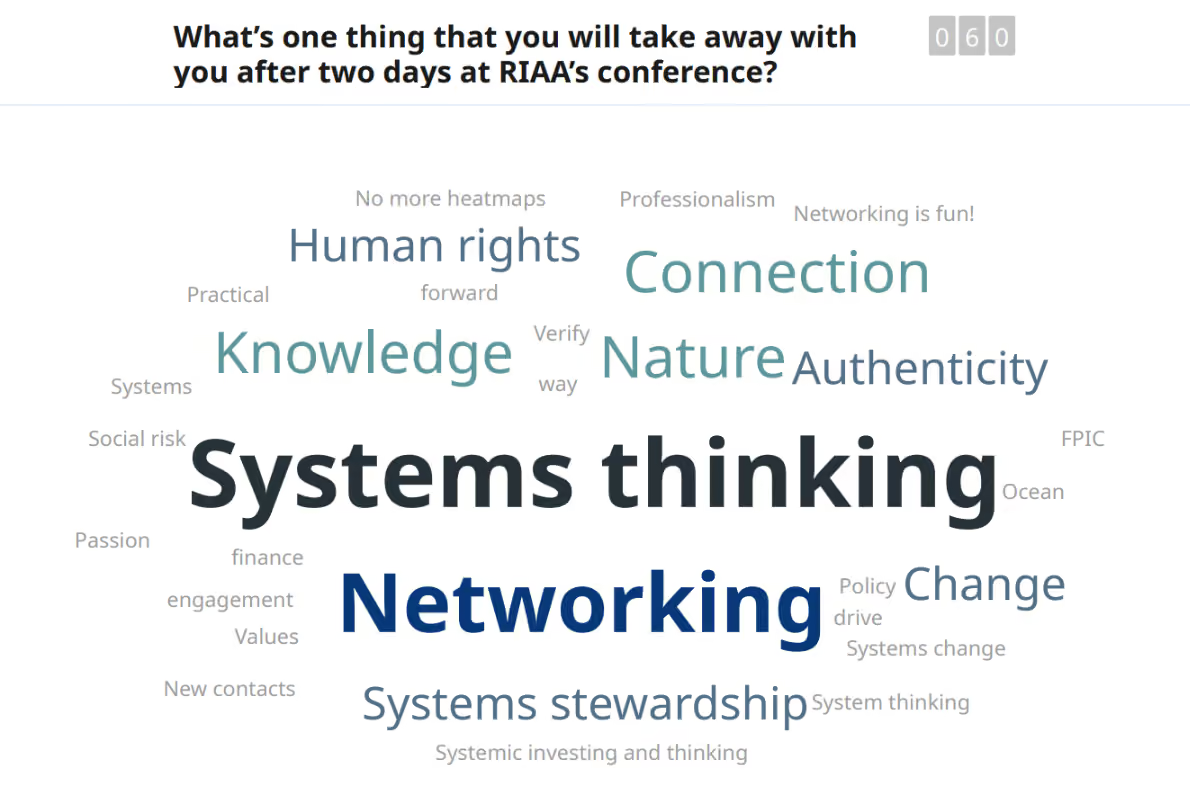
Slido wordcloud: What attendees told us about the conference
<hr>
<small> Disclaimer: The above content is provided by Responsible Investment Association Australasia (ACN 641 046 666, AFSL 554110) for information purposes and is not an offer to buy or sell a financial product, and is not warranted to be correct, complete or accurate. For more information refer to our Financial Services Guide on the RIAA website. Any general advice has been provided without reference to your investment objectives, financial situation or needs. If the advice relates to the acquisition of a particular financial product for which an offer document (such as a product disclosure document) is available, you should obtain the offer document relating to the particular financial product and consider it before making any decision whether to acquire the product. Past performance does not necessarily indicate a financial products’ future performance. To obtain information tailored to your situation, contact a financial adviser.

Co-CEO
,
RIAA
With a distinguished 20-year career at the Department of Foreign Affairs and Trade, Estelle Parker brings crucial expertise in government relations, policy-making, and themes important to responsible investors, including human rights and the SDGs. As a leader driving RIAA’s research, certification, policy, standards, and working group programs, her leadership has elevated these initiatives to achieve heightened levels of professionalism, impact, and value delivery for our members, aligning seamlessly with RIAA’s strategic objectives.
Beyond her organisational impact, Estelle is a respected figure in the responsible investment landscape, serving as a strong advocate on influential global and government committees, including the Principles for Responsible Investment’s Global Policy Reference Group, the Global Sustainable Investment Alliance (as a Board member) and the Australian Government’s Natural Capital Working Group. Additionally, she serves as the Convenor of the Taskforce on Nature-Related Financial Disclosures official Consultation Group for Australia and Aotearoa New Zealand, and the Steering Committee for the Australian Sustainable Finance Institute. She is also the Vice President of the Council of the Australian Institute for International Affairs (Victoria).
.jpg)
.avif)