
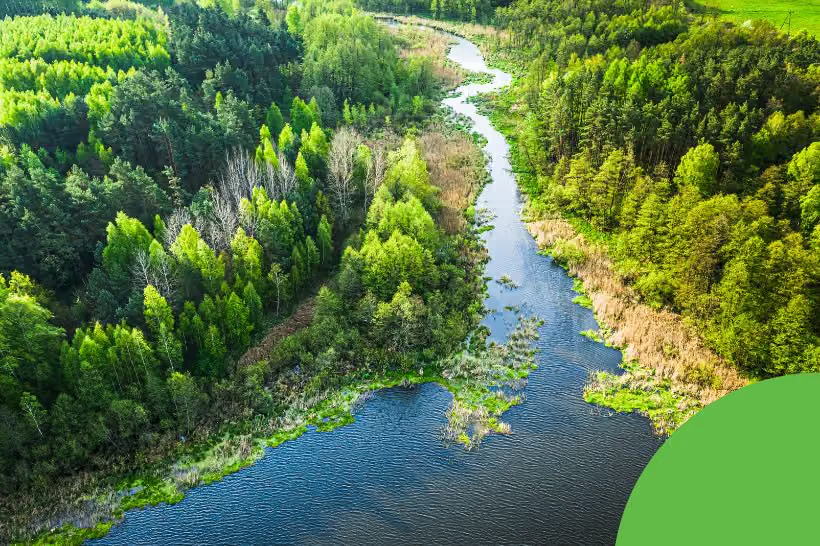
As bushfires and floods ravage the country and heatwaves loom in Sydney and Melbourne, business owners and executives would do well to consider the implications of changing weather for the future of their business.
Back in 2013, Four Degrees of Global Warming: Australia in a hot world, edited by University of Melbourne academic Peter Christoff, outlined the social, economic, health and environmental impacts that a warming planet would bring to the Australian continent. The book foreshadowed significant disruptions to agriculture patterns, water supplies, energy supplies and marine resources, and highlighted the significant costs of adaptation.
We’re now seeing many of these warnings come to pass, with assets increasingly uninsurable, supply chains disrupted and infrastructure destroyed or damaged by extreme weather. Not to mention the productivity loss that extreme heat causes. Forecasts from the NSW Climate Data Portal show Sydneysiders could experience double the number of days over 35 degrees within the next 15 years.
In his 2021 review for the UK Government, Professor Sir Partha Dasgupta gave similar warnings about the economic impacts of nature loss, describing nature as “our most precious asset” and highlighting the services – like clean soil, air and water – that nature provides to economic activity.
It will be no surprise to those familiar with the research that in its latest global risks report released last month, the World Economic Forum listed extreme weather events, biodiversity loss/ecosystem collapse and “critical change to Earth systems” as the three most salient long-term risks facing the global economy. But over recent years they’ve added a string of other short- and long-term risks to their annual stocktake. The index now includes a mind-boggling range of issues, including geoeconomic confrontation, misinformation, human rights erosion, inequality and social polarisation.
In 2026, it is more urgent than ever that businesses understand what these non-financial risks mean for their operations, the products they make, the infrastructure they rely on and the markets they serve.
The good news is, there are frameworks – supported by fast-improving tech such as geospatial mapping and AI-supported scenario analysis – that businesses can use to consider the risks that these non-financial factors pose to their bottom line.
When making and managing investments, investors also use a range of strategies to factor in long-term trends alongside financial performance. Analysing the exposure of companies to environmental, social and governance (ESG)-related risks is a first step. Investors are also increasingly examining whether companies are positioned to harness opportunities – like investing in climate change adaptation or nature-based mitigation solutions – that the mega-trends currently on show in the global economy will bring. This integration of ESG factors into decision-making helps investors get their risk-return profiles right for the long-term.
Investors are also increasingly deploying their rights to protect and enhance the long-term value of investee companies through filing shareholder resolutions, voting at AGMs or engaging with investee companies’ boards and executives. This investor stewardship – also called active ownership or corporate engagement – now sits alongside ESG Integration as the most widely-used responsible investment approach by Australian investors.
Smart investors have long known that there is more that drives investment returns than just what is reported in financial reports. With the impacts of climate change and nature loss already upon us, it is clear that many companies won’t survive if they ignore these trends. And they won’t thrive unless they account for the environmental, social and corporate governance issues facing companies today.
<hr>
<small> Disclaimer: The above content is provided by Responsible Investment Association Australasia (ACN 641 046 666, AFSL 554110) for information purposes and is not an offer to buy or sell a financial product, and is not warranted to be correct, complete or accurate. For more information refer to our Financial Services Guide on the RIAA website. Any general advice has been provided without reference to your investment objectives, financial situation or needs. If the advice relates to the acquisition of a particular financial product for which an offer document (such as a product disclosure document) is available, you should obtain the offer document relating to the particular financial product and consider it before making any decision whether to acquire the product. Past performance does not necessarily indicate a financial products’ future performance. To obtain information tailored to your situation, contact a financial adviser.

Co-CEO
,
RIAA
With a distinguished 20-year career at the Department of Foreign Affairs and Trade, Estelle Parker brings crucial expertise in government relations, policy-making, and themes important to responsible investors, including human rights and the SDGs. As a leader driving RIAA’s research, certification, policy, standards, and working group programs, her leadership has elevated these initiatives to achieve heightened levels of professionalism, impact, and value delivery for our members, aligning seamlessly with RIAA’s strategic objectives.
Beyond her organisational impact, Estelle is a respected figure in the responsible investment landscape, serving as a strong advocate on influential global and government committees, including the Principles for Responsible Investment’s Global Policy Reference Group, the Global Sustainable Investment Alliance (as a Board member) and the Australian Government’s Natural Capital Working Group. Additionally, she serves as the Convenor of the Taskforce on Nature-Related Financial Disclosures official Consultation Group for Australia and Aotearoa New Zealand, and the Steering Committee for the Australian Sustainable Finance Institute. She is also the Vice President of the Council of the Australian Institute for International Affairs (Victoria).
.jpg)
.avif)