
Download the full submission here, for responses to consultation questions.
RIAA broadly supports the proposed direction of the proposed reforms to improve regulatory visibility of the managed investment scheme (MIS) sector through enhanced data collection. Improving the quality, consistency and availability of information across registered and unregistered MISs would strengthen regulatory oversight and help regulators identify emerging risks, including risks associated with scheme structures, underlying assets, liquidity, leverage, investor flows and material linkages across the financial system.
Transparency is also fundamental to responsible investment and to informed consumer participation. Investors increasingly expect to understand where and how their money is invested. RIAA’s From Values to Riches 2024 research found that three quarters of Australians consider it important to know which companies their investments are invested in, while 76% consider it important to know the real-world outcomes of their funds. Greater availability of decision-useful information can therefore support both market integrity and help retail investors understand and compare investment products and assess whether product claims align with actual investments.
The development of the enhanced MIS framework provides an opportunity to build on existing regulatory and industry disclosure standards while addressing material gaps in coverage and look-through transparency. In particular, RIAA supports extending portfolio holdings disclosure beyond superannuation to managed investment schemes and requiring meaningful look-through to underlying assets, including where investments are held or managed through external investment managers, pooled vehicles or other intermediary structures: see our response to ASIC’s Australia’s evolving capital markets discussion paper.
RIAA’s Responsible Investment Certification Program demonstrates that enhanced portfolio transparency can be implemented in practice. Certified products must publish portfolio holdings at least twice annually, with no more than a 90-day lag, and meet relevant look-through requirements. The program also provides a mechanism for addressing legitimate confidentiality concerns while requiring full holdings to be provided to RIAA for assessment.
RIAA considers that the enhanced MIS framework should be:
- purpose-driven, with each collection linked to a clear regulatory or policy use case;
- proportionate, with requirements tailored to relevant scheme, asset, investor and information characteristics rather than relying on broad exclusions;
- coordinated across government, including through a “tell us once” approach and reuse of information already reported;
- capable of providing meaningful look-through to underlying exposures;
- developed through genuine consultation, supported by clear guidance, standardised reporting arrangements and appropriate transition periods; and
- subject to review and continuous improvement, beginning with the proposed three-year post-implementation review
Regulatory collection and public disclosure should be treated as related but distinct questions. Information needed for supervision may not always be suitable for public release. Where information is suitable for publication, however, transparency should be the starting point, with narrowly framed and clearly justified exceptions for genuinely confidential, commercially sensitive, market-sensitive or privacy-related information. Where full publication is not appropriate, delayed, aggregated or otherwise limited disclosure should be considered before information is withheld entirely.
At a high level, RIAA considers that the framework should be purpose-driven, proportionate and coordinated across government, taking into account relevant recommendations made by the Productivity Commission’s inquiry into business reporting requirements. It should improve regulatory visibility of registered and unregistered MISs, support meaningful look-through of underlying exposures, minimise unnecessary duplication and be developed through genuine consultation with affected entities and industry stakeholders. Regulatory collection should also be distinguished from public disclosure. For information that is suitable for public release, RIAA considers that transparency should be the starting point, with appropriately targeted exceptions where there is a clear justification for non-disclosure.
RIAA would welcome continued engagement with Treasury on the detailed design of the framework, including information concerning investment strategy and objectives, ESG-related commitments, material sustainability factors, portfolio holdings and implementation arrangements. These requirements should be proportionate, decision-useful and aligned with relevant reporting, product disclosure and sustainable finance reforms.
Summary of recommendations
Recommendation 1: Improve regulatory visibility across the MIS sector through proportionate, purpose-driven data collection.
Recommendation 2: Extend portfolio holdings disclosure beyond superannuation to managed investment schemes and require full, asset-level disclosure on a meaningful look-through basis.
a) Make portfolio information usable while protecting genuinely sensitive information with a “comply or explain” approach.
b) Create an accessible portfolio disclosure register.
Recommendation 3: Include investment strategy, objectives and ESG commitments in baseline information, and consider proportionate collection and disclosure of material sustainability information.
Recommendation 4: Improve visibility of unregistered MISs, recognising that greater regulatory visibility remains valuable even where complete coverage is not initially achievable.Improve visibility of unregistered MISs.
Recommendation 5: Establish a presumption in favour of public transparency for information suitable for disclosure, with narrowly defined and justified exceptions.
Recommendation 6: Minimise duplication by coordinating requirements across government, reusing information already reported where appropriate and applying a “tell us once” approach.
Recommendation 7: Embed review and continuous improvement, including the proposed three-year post-implementation review and consideration of further periodic reviews.
General submissions
Build on existing disclosure frameworks and expand portfolio holdings disclosure (PHD) regime
The development of enhanced MIS data collection and disclosure should begin with existing reporting and disclosure frameworks, rather than creating an entirely separate architecture. Australia’s portfolio holdings disclosure requirements for superannuation provide an important starting point and demonstrate an existing regulatory approach to improving visibility of investment portfolios but are materially limited to be able to provide meaningful insight into the MIS sector.
RIAA strongly supported the introduction of portfolio holdings disclosure (PHD) for registerable superannuation trustees (RSEs) in the Corporations Amendment (Portfolio Holdings Disclosure) Regulations 2021 (PHD Regulations). This was an important step to bring Australia closer to global leading disclosure practices and to make it easier for superfund members to compare products and identify the most suitable fund for them. However, there are material limitations in the existing portfolio holdings disclosure regime. In its response to ASIC’s Australia’s evolving capital markets discussion paper, RIAA noted that the current requirements apply to the superannuation sector but not more broadly to registered MISs, creating a gap in disclosure coverage between superannuation and the broader managed funds industry
RIAA also identified limitations in look-through transparency where investments are managed externally. The existing regime does not require reporting to the underlying asset level where assets are managed by external investment managers. RIAA’s submission argued that the prevalence of external management can therefore result in material information about underlying investments not being publicly disclosed.
Australia is a notable laggard in its transparency, when compared to other developed economies. Morningstar Manger Research into global best practice for managed funds found Australia continues to significantly lag behind other developed countries on disclosure practices. Despite the introduction of PHD Regulations in 2021, the report finds that “Australia continues to have the weakest portfolio disclosure requirements in the developed world”. The current status of Australia’s PHD Regulations puts Australia out of step with its peers and impacts consumer participation, market transparency and capacity for regulatory oversight, as well as understanding of responsible investing and progress towards Australian Government priorities such as net-zero targets.
The current PHD regime does not provide information on how responsible investing strategies are carried across a portfolio. The current level of PHD does not allow consumers/retail investors to fully check that their investments, and the product claims, are in line with their values, which increase the risk of consumers being misled (i.e. Greenwashing). Appropriate transparency of portfolio holdings can mitigate greenwashing by enabling consumers to understand their investments and hold investment managers to account for claims or promotional material which represent sustainability credentials.
Recommendations:
- Reform existing PHD Regulations to:
- apply industry-wide and include full, asset level portfolio holdings disclosure on a look-through basis that is meaningful to the end-user (beneficiary, i.e. consumer and/or retail investor) and goes beyond associated entities (i.e. fund managers) to the assets themselves;
- remove the requirement from PHD regulations to provide pricing information from all disclosures, assisting with the complexity of valuation of some asset classes (for example, private assets).
- apply industry-wide and include full, asset level portfolio holdings disclosure on a look-through basis that is meaningful to the end-user (beneficiary, i.e. consumer and/or retail investor) and goes beyond associated entities (i.e. fund managers) to the assets themselves;
- Introduce a “comply or explain” framework for market sensitive information (which may include valuations) to ensure transparency is the default and non-disclosure is the exception.
- Provide clear and useful regulatory guidance on appropriate disclosure related to private assets, including valuations. For example, providing a list of individual private asset holdings with an aggregate value of the asset class (at manager or asset class level).
- Develop a disclosure register for all managed investment schemes to upload portfolios which is usable for regulators (to support market oversight) and consumers (to allow informed investment decision-making).
Current market practice on portfolio holdings disclosure
Greater transparency is also achievable in practice. Existing industry practice demonstrates that more comprehensive portfolio transparency is possible for both managed funds and superannuation funds and provides a useful foundation for considering how disclosure could be strengthened and made more consistent across the managed funds sector. RIAA considers that the design of any additional requirements should nevertheless be proportionate and developed through consultation, including appropriate consideration of genuinely commercially sensitive or market-sensitive information.
The Responsible Investment Benchmark Report Australia 2024 recognises that full portfolio holdings disclosure is an indicator of leading responsible investment practice, reflecting that some investment managers voluntarily provide transparency beyond minimum disclosure requirements.

RIAA’s Responsible Investment Certification Program provides an established example of enhanced portfolio transparency being implemented in practice. Products certified by RIAA must meet RIAA’s Responsible Investment Standard, which establishes requirements relating to responsible investment processes, claims, stewardship and relevant and accessible disclosures.
Portfolio holdings transparency is an important component of the Standard and goes beyond relevant Australian legislative requirements. The Standard requires certified products to:
- publish portfolio holdings at least twice annually,
- with no more than a 90-day lag, and
- include fund look-through and derivatives for equities funds, or equivalent disclosure for other products.
The Certification Program therefore provides practical evidence that more comprehensive portfolio transparency can be implemented by investment products beyond minimum regulatory requirements. Guidance Note P5c Portfolio Holdings Disclosure is also pragmatic, recognising that PHD needs to accommodate legitimate confidentiality concerns, providing for particular assets to seek an exemption from public disclosure of some holdings where relevant and reasonable privacy or confidentiality issues exist. Full holdings must nevertheless be provided to RIAA for assessment, including to test consistency with the product’s responsible investment strategy and compliance with the Standard. RIAA’s experience demonstrates that increased transparency and appropriate protections for genuinely sensitive information need not be mutually exclusive.
As at 30 September 2026, a total of 351 products were offered by 73 issuers in one or more of Australian, New Zealand or global markets. When looking at products being offered only in Australia (and therefore only subject to Australian PHD requirements), there are 110 products from 39 issuers which are subject to the Standard’s extended transparency requirements. Of these:
- 19 (17%) are superannuation products from 6 (15%) issuers; and
- 87 (79%) are investment products from 30 (77%) issuers.
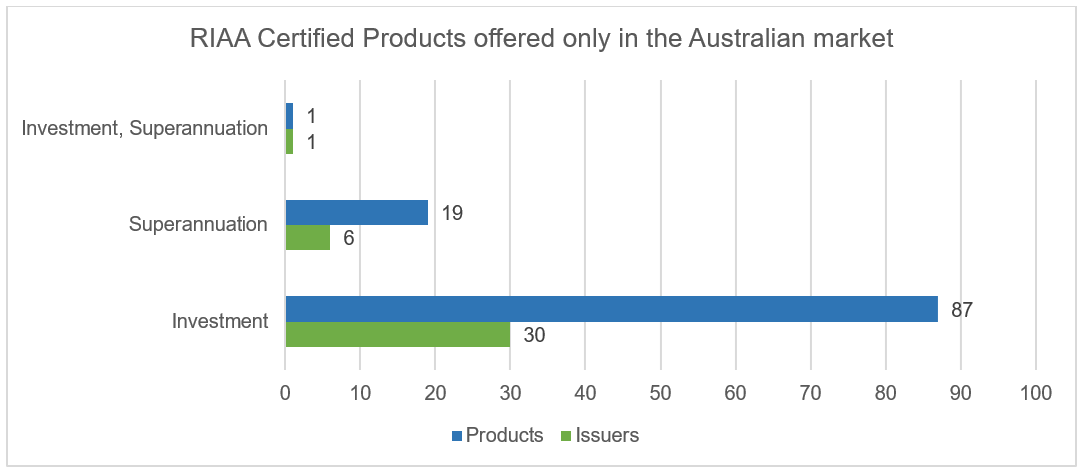
In terms of market exposure, these certified products cover both retail and wholesale:

This existing industry practice demonstrates that more comprehensive portfolio transparency is possible and provides a useful foundation for considering how disclosure could be strengthened and made more consistent across the managed funds sector. RIAA considers that the design of any additional requirements should nevertheless be proportionate and developed through consultation, including appropriate consideration of genuinely commercially sensitive or market-sensitive information.
Develop a proportionate and coordinated framework through genuine consultation
The framework should be coordinated across government and designed to reduce duplication. Differences in treatment should reflect relevant characteristics such as asset class, scheme structure, investor base and sensitivity of information, rather than broad exclusions.
Detailed reporting fields, frequency and implementation arrangements should be developed through genuine consultation with affected entities and industry stakeholders. Such consultation will be integral to developing a framework that is proportionate, workable and appropriately aligned with relevant disclosure requirements.
As the framework is developed, consideration should also be given to whether the collection and, where appropriate, disclosure of information relating to material sustainability factors could improve regulatory visibility, transparency and investor understanding. The appropriate scope and form of any such requirements should be determined through consultation and should be proportionate, decision-useful and aligned with relevant sustainability-related disclosure requirements. RIAA would welcome the opportunity to contribute to the design of these aspects of the framework.
Clear guidance and appropriate transition periods will also be important to effective implementation.
Make public transparency the default where information is suitable for disclosure
Information collected confidentially for regulatory supervision should be distinguished from information suitable for public release. For information that is suitable for public disclosure, the framework should establish a presumption in favour of transparency: information should be made publicly available unless there is a clear and justifiable reason for withholding it.
Public access to MIS data can improve transparency, comparability and accountability. The onus should therefore be on demonstrating why information should not be disclosed, rather than why it should be. Exceptions should be limited to information that is genuinely confidential, commercially sensitive or market-sensitive, supported by clear criteria and accountable, case-by-case decisions.
‘Download submission’ for full RIAA response.
