
.avif)
Details
Speakers
As artificial intelligence rapidly reshapes markets, business models and society, investors face a defining question: is there an ethical way to invest in, use and govern AI? This session will unpack the systemic risks and opportunities of AI for institutional and impact investors, from algorithmic bias, data privacy and labour displacement to market concentration, energy and water demand, and the carbon footprint of AI infrastructure.
Leading thinkers in AI ethics, finance and responsible investment will confront the tensions head-on: AI can accelerate climate modelling, healthcare diagnostics, sustainability analysis and productivity, yet it also creates new risks that traditional exclusion-based approaches may struggle to address. For investors with diversified portfolios and long-term beneficiaries, understanding these trade-offs is no longer optional.
Attendees will leave with a sharper understanding of how AI is changing investment decision-making, where systemic risks may emerge across portfolios and financial markets, and what responsible AI use, stewardship, engagement and risk assessment can look like in practice. This session is designed for investors who want to move beyond hype and avoidance, and instead utilise AI responsibly in investment decision-making, and develop a more sophisticated approach to navigating AI’s ethical, financial and real-world impacts.
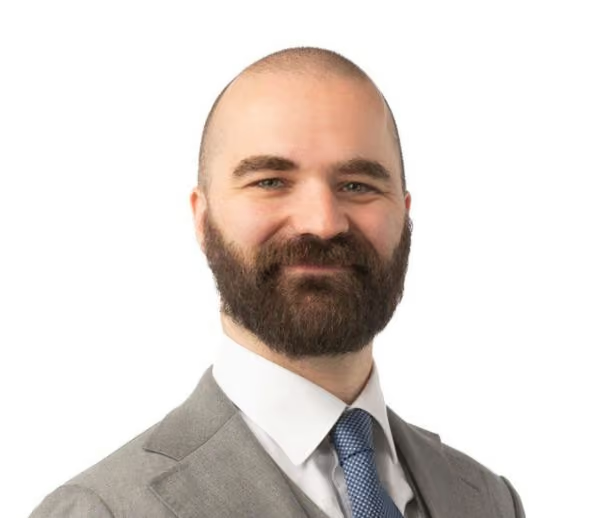
Senior Lecturer of Finance at the University of Melbourne
Antoine Didisheim is a Senior Lecturer in Finance at the University of Melbourne, specialising in artificial intelligence and machine learning applications in investment management. His research, recognised with the Q-Group's Jack Treynor Prize, has been featured in the Financial Times and on the ABC. Beyond academia, Antoine consults for major Australian superannuation funds, including Cbus and Aware Super, helping institutional investors evaluate where AI adds genuine strategic value — from asset pricing and risk management to the analysis of financial news.

AI Ethicist and Lecturer in AI at University of Auckland
Dr Kerry McInerney (Ngāti Ruanui) is a Lecturer at the University of Auckland School of Computer Science and an Associate Fellow at the Leverhulme Centre for the Future of Intelligence (LCFI) at the University of Cambridge. She is an AHRC/BBC Radio 3 New Generation Thinker, and was previously a Research Fellow at the AI Now Institute (a leading AI policy think tank in New York). Kerry’s research explores the intersections between AI ethics, data ethics, social justice, and inequality.
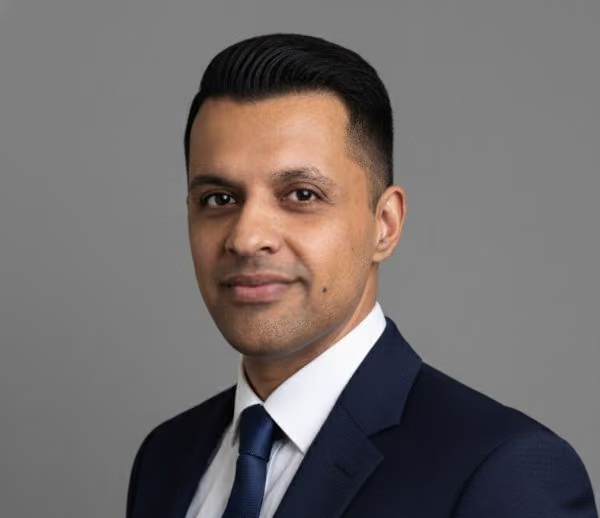
Manager, Responsible Investments at Betashares
Vinnay Cchoda is a responsible investment professional with nearly two decades of experience spanning investment management, sustainability and technology-focused strategy consulting. He specialises in integrating environmental, social and governance (ESG) considerations across equities, fixed income and multi-asset portfolios, helping investors navigate the intersection of sustainability, regulation and long-term value creation.
As Manager, Responsible Investments at Betashares, one of Australia's leading fund managers, Vinnay is a member of the portfolio management team and helps shape the firm's responsible investment strategy. He oversees ESG research, stewardship, proxy voting, controversy assessment and responsible investment product development across the firm's ethical and sustainability-focused investment strategies, working closely with portfolio managers, clients and industry stakeholders to translate complex sustainability issues into practical investment outcomes.
He is passionate about helping investors understand how sustainability, technological disruption and evolving regulation are reshaping capital markets, and how these forces are creating both risks and opportunities for long-term investors. Vinnay is a regular contributor to Livewire and FS Sustainability. He holds a Bachelor of Commerce from the University of Mumbai, a Master of Science in Finance, and has completed executive education at Harvard University and the University of Cambridge in climate finance, sustainable business strategy and ESG integration.
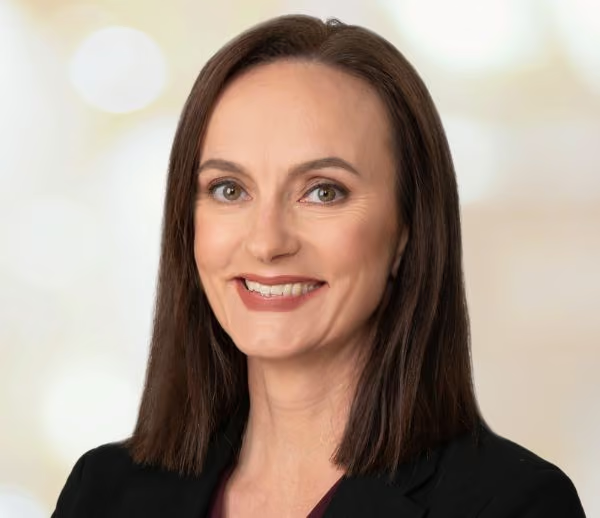
Co-CEO of RIAA
Estelle Parker leads RIAA’s research, certification, policy, standards and working group programs. She brings 20 years’ experience leading strategic initiatives as a diplomat, policy analyst, stakeholder manager and strategic planner with the Department of Foreign Affairs and Trade (DFAT). Estelle served, inter alia, as Acting Ambassador and Deputy Ambassador to Mexico, Central America and Cuba; Deputy State Director (Victoria); Policy Adviser to the Regional Assistance Mission to Solomon Islands; and as Director overseeing the development and management of bilateral relationships.
Estelle also worked for five years at the University of Melbourne, where she lectured in the Master of Public Policy and Management and Master of International Relations, and has experience on boards and committees. She is currently a member of the Principles for Responsible Investment’s Global Policy Reference Group and the Australian Government’s Natural Capital Working Group, as well as Convenor of the Taskforce on Nature-Related Financial Disclosures official Consultation Group for Australia and Aotearoa New Zealand.
Estelle holds a Master of Public Policy and Management (First Class Honours), Master of Communications (With Distinction), Bachelor of Arts (av. First Class Honours) and Certificate in Business Sustainability Strategy.


